
Environment-framed networks: seasonal reconfiguration of service accessibility in Arctic transport systems
Published in Applied Network Science, 2026
Georgii Kontsevik, Alina Gubina, Valeria Tikhevich, Sergey Mityagin (2026). Environment-framed networks: seasonal reconfiguration of service accessibility in Arctic transport systems. Applied Network Science, 11, 35.
An Environment-Framed Network (EFN) model for studying how seasonal transport conditions change access to services in Arctic settlements.
Model
The transport backbone combines regular roads, winter roads, water transport and aviation. Temperature determines which links are available, while travel-time limits constrain access to service providers. Network layers represent population flows for individual services. As transport conditions change, the model recalculates feasible connections and redistributes demand between providers.
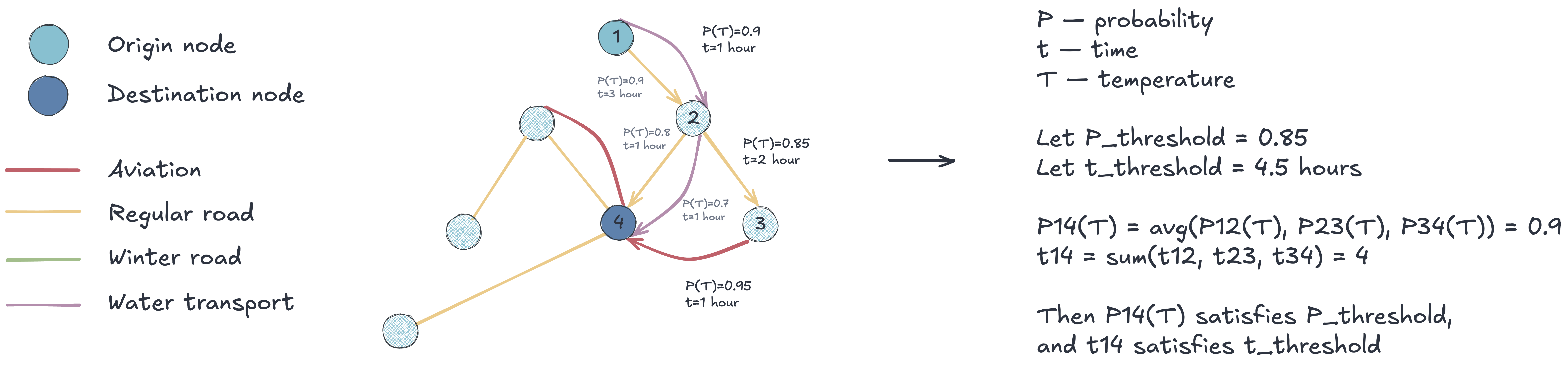
Network overview from the project repository. Click the scheme to open the full-size image.

Findings
Across four Arctic regional settlement systems, up to 40% of settlements change service providers, while 15–20% become temporarily isolated for 2–4 months during seasonal transitions. The study examines both transport connectivity and the stability of service catchments.
Paper and code
Georgii Kontsevik, Alina Gubina, Valeria Tikhevich and Sergey Mityagin. Environment-framed networks: seasonal reconfiguration of service accessibility in Arctic transport systems. Applied Network Science, 11, 35 (2026).
Read the open-access paper · Code, notebooks and figures on GitHub